✦ 100% QC Inspected ✦ Built for Protectors ✦ Backed by Our Covenant ✦
How to Build a Sub-MOA AR-15: A 2026 Guide
A practical guide to building a sub-MOA AR-15 in 2026. Barrel, trigger, ammo, optic, and the small details that separate a 2 MOA gun from a real shooter.
PRECISION RIFLE GUIDES: RELOADING, BUILDS & LOAD DEV | SENTINEL
David Henry
5/27/20268 min read
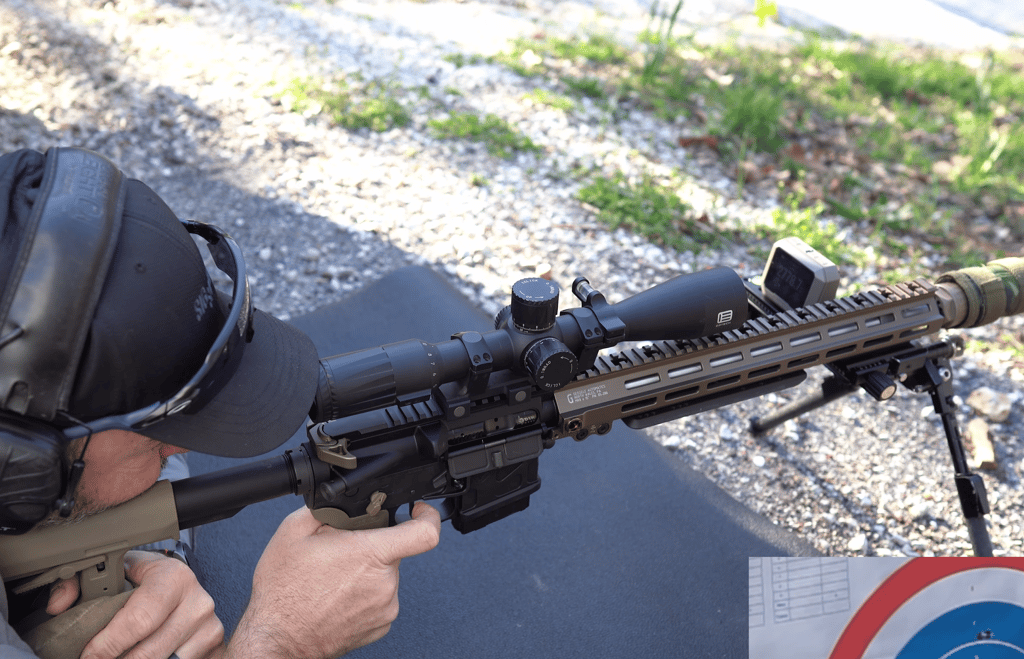
How to Build a Sub-MOA AR-15: A 2026 Guide
Everybody wants a sub-MOA AR-15. Most people end up with a 1.5 MOA gun that shoots one 0.8 MOA group on a good day and call it sub-MOA forever. There's a difference, and the difference is everything when you're trying to make a real shot at distance.
A sub-MOA AR-15 by which we mean a rifle that consistently delivers groups under one minute of angle with quality ammunition, not a rifle that did it once on a still day isn't built by buying expensive parts. It's built by understanding which parts move the accuracy needle, which ones don't, and where the small details actually live.
This is a working-shooter breakdown. By the end you'll know exactly where to spend your money, where to save it, and what separates a real precision AR-15 from an expensive lookalike.
What "Sub-MOA" Actually Means
One minute of angle is approximately one inch at 100 yards, two inches at 200, three at 300, and so on. A true sub-MOA rifle puts five shots inside that circle on demand not three, not on one lucky range trip. Five shots, repeatable, with quality ammunition, in normal conditions.
A few hard truths most build articles skip:
Three-shot groups don't count. Anyone can shoot a tight three-shot group from a 2 MOA rifle. The fourth and fifth shots are where statistical truth shows up. If your sub-MOA claim is built on three-shot groups, you have a 1.2 to 1.5 MOA rifle that occasionally throws three good shots.
The shooter has to be capable. A 0.5 MOA rifle in the hands of a 1.5 MOA shooter is a 1.5 MOA system. Buying parts past your skill level is just buying frustration. Build the gun your shooting can actually use.
Ammunition selection matters as much as parts selection. A sub-MOA AR-15 with bulk ammo is a 2 MOA rifle. The ammunition is half the equation. Most builds fail this test they're capable rifles fed garbage ammo and judged on the result.
With those out of the way, here's how to build the rifle.
The Components That Actually Drive Accuracy
In rough order of impact, here's where AR-15 accuracy comes from.
1. Barrel (Massive Impact)
The barrel is the single largest variable in AR-15 accuracy. A premium barrel can drag a mediocre rifle into sub-MOA territory. A bad barrel makes a $4,000 build shoot like an Anderson lower.
What to look for in 2026:
Quality steel. 416R stainless or premium chrome moly. Skip mil-spec carbon barrels for precision builds they're built for volume, not precision.
Cut rifling or button rifling from a serious manufacturer. Hammer-forged barrels exist in this space too, but cut and button are the precision-shooter standards. Names that consistently deliver: Proof Research, Bartlein, Krieger, Hawk Hill, Brux, Rock Creek, Lothar Walther. Mid-tier names that punch above their price: Ballistic Advantage, Faxon Match Series, Criterion.
Match chamber. A 5.56 NATO chamber is built loose for reliability. A .223 Wylde chamber is the standard precision compromise feeds 5.56 reliably, shoots .223 match ammo to its potential. For most precision AR builds, .223 Wylde is the right answer.
Twist rate matched to your bullet weight. 1:8 is the sweet spot for 69-77 grain match bullets. 1:7 if you're running heavier. 1:9 only if you're sticking to 55-69 grain ammo and never plan to run heavies.
Length: 18-20" is the sweet spot for precision. 16" works fine but you'll lose 100-150 fps. Past 20" you're giving up handling for marginal velocity gains in this caliber.
We'll do a full barrel breakdown in a later post. For now: spend money here. It's the most important part on the rifle.
2. Ammunition (Massive Impact)
You cannot shoot sub-MOA with bulk 55-grain blasting ammo. Period. The ammunition has to match the rifle's purpose.
For factory match ammo, the names that consistently deliver in precision AR-15s:
Federal Gold Medal Match (69gr or 77gr SMK)
Hornady Match (75gr or 73gr ELD)
Black Hills MK262 Mod 1 (77gr)
IMI Razor Core (77gr)
Test multiple loads. Every barrel has a preference. The barrel that loves 77gr Sierras might shoot 75gr Hornadys at 1.3 MOA. You won't know until you test.
For serious precision, handloading is the answer. A tuned handload for a specific barrel will outperform any factory ammunition by a meaningful margin. We'll cover load development in detail in the reloading series this is where the gap between a good AR-15 and a great one really opens up.
3. Trigger (Significant Impact)
A bad trigger doesn't make the rifle inaccurate. It makes the shooter inaccurate. Same effect, different cause.
The mil-spec trigger that comes in most factory ARs is built for combat 5.5-8.5 lb pull, gritty, two-stage with a long reset. That's not what you want for precision.
For precision, look for:
2.5-4 lb pull weight. Light enough for clean breaks, heavy enough for safety.
Single-stage or two-stage match. Personal preference. Two-stage gives more feedback. Single-stage breaks cleaner. Try both.
Crisp, glass-rod break with minimal creep.
Names worth your money in 2026: Geissele (SSA-E, Super Dynamic 3-Gun, Hi-Speed National Match), Timney (Calvin Elite, AR-15 Targa), TriggerTech (Diamond, Adaptable), LaRue MBT-2S (the budget winner), CMC, and Ballistic Engineering.
A great trigger costs $200-$350. It's the highest-ROI accuracy upgrade after the barrel.
4. Bedding and Receiver Fit (Moderate Impact)
A sloppy upper-to-lower fit transfers stress into the barrel and shifts point of impact unpredictably. A tight fit doesn't.
You can address this with:
A matched upper/lower set from a quality manufacturer (Aero Precision M5 series, LaRue, Knight's Armament, etc.).
An accuwedge or rubber tensioner for budget builds basic but effective.
A free-floated handguard that does not contact the barrel anywhere except at the receiver.
Free-floating the barrel is non-negotiable for precision. If your handguard touches the barrel anywhere, the rifle will not shoot consistently.
5. Bolt Carrier Group (Minor Direct Impact, Major Indirect Impact)
The BCG itself doesn't significantly affect accuracy on a well-built rifle. What it does affect is reliability and timing — and a rifle that doesn't run reliably can't be tuned reliably.
For precision builds:
Full-mass BCG, not lightweight. Lightweight carriers are for competition where cycling speed matters more than precision.
MPI/HPT tested bolt from a serious manufacturer.
Properly staked gas key.
Don't overspend here. A quality $200 BCG (Toolcraft, Microbest, Aero Premium) does the job. The $400 nickel boron and titanium options are mostly cosmetic for precision purposes.
6. Optic (Massive Impact on Effective Accuracy)
A 0.5 MOA rifle with a 2 MOA red dot is a 2 MOA system at distance. The optic has to match the rifle's capability or you're throwing the build away.
For sub-MOA precision AR-15s in 2026:
LPVO 1-6x or 1-8x with a quality reticle.
Fixed-power prism scope if you want simplicity. ACOG, Trijicon TA-110, etc.
Mid-magnification scope (3-15x or 4-16x) if the rifle is dedicated to bench/distance shooting.
Mount matters too. Quality one-piece cantilever mount with proper torque specs. Don't bolt a $2,500 LPVO to a $40 mount.
7. Gas System (Moderate Impact via Reliability)
For precision, you want the gas system tuned correctly not over-gassed (which beats the rifle and shifts point of impact), not under-gassed (which causes failures to extract under match conditions).
An adjustable gas block lets you tune for the ammunition you're shooting. For precision builds, this is worth the $80-$150 upgrade. SLR, Superlative Arms, Seekins all make good ones.
Mid-length or rifle-length gas systems are smoother than carbine-length and easier on the rifle. For precision builds, prefer rifle-length on 18"+ barrels and mid-length on 14.5-18" barrels.
What Doesn't Matter As Much As You Think
The internet will sell you upgrades that don't move the needle. Save the money.
Buffer and spring upgrades. A correctly-spec'd buffer for your gas system matters. A $90 "match" buffer doesn't shoot tighter groups than a $25 standard one if both are correctly weighted.
Charging handle. Has zero impact on accuracy. Buy whatever you like the ergonomics of.
Forward assist and dust cover. Don't matter for precision. Some builders delete them for weight or looks. Doesn't change groups.
Muzzle device. Has minor impact on accuracy through harmonics, but the difference between a quality flash hider and a quality compensator is in the noise. Match the device to your suppressor or your shooting environment, not to a promised accuracy gain.
Stock and grip. Affect shooter comfort and consistency, not the rifle's mechanical accuracy. Get something that fits you. Don't pay $300 for a stock when a $100 one fits identically.
A Complete Sub-MOA Build at Three Price Points
Here's how the math works at three real budgets in 2026.
Budget Build (~$1,800-$2,200)
Aero Precision M4E1 upper/lower set
Ballistic Advantage 18" .223 Wylde Premium barrel
Toolcraft BCG
Quality mid-length gas system, adjustable gas block (SLR)
LaRue MBT-2S trigger
Aero Atlas R-One free-float handguard
Magpul stock and grip
entry level optic
This build will shoot sub-MOA with quality ammunition. We've seen them deliver 0.8-1.2 MOA five-shot groups consistently. The bottleneck at this price point is usually the optic upgrade the glass first when you can.
Serious Build (~$3,500-$4,500)
Quality matched billet upper/lower (Mega Arms, Sons of Liberty, V Seven)
Criterion or Faxon Match 18" barrel or a Proof Research carbon if weight matters
Quality BCG with full nitride or premium coatings
Geissele SSA-E or TriggerTech Diamond trigger
Quality free-float rail (Geissele, Aero Atlas S-One, Midwest Industries Combat)
Adjustable gas block, rifle-length gas
Magpul PRS Lite or Luth-AR MBA-4 stock for benched shooting
Min to high end optic
This is the sweet spot for most serious precision AR builds. Capable of 0.7-1.0 MOA with tuned ammunition. The build most working precision shooters land on after one or two iterations.
No-Compromise Build (~$6,000+)
Premium custom-built upper from a serious gunsmith
Proof Research, Bartlein, or Krieger barrel — match-chambered
Geissele Super Dynamic or Hi-Speed National Match trigger
Premium BCG with hand-fitted bolt
Carbon fiber free-float handguard
Premium scope ( in higher magnification)
Atlas bipod or MDT and a quality rear bag
Capable of 0.5-0.7 MOA when fed tuned handloads. The ceiling of the platform.
The Small Details That Separate the Best from the Rest
A few things that don't appear on parts lists but make significant differences.
Barrel break-in. Modern premium barrels need less than the old protocols suggested, but they still benefit from correct break-in. Follow the manufacturer's specific protocol.
Torque specs. Use a torque wrench on your barrel nut, scope mount, scope rings, and action screws. "Tight enough" isn't a torque spec. Inconsistent torque means inconsistent point of impact.
Cleaning regimen. Precision rifles need to be cleaned correctly, not constantly. Bore guide, quality rod, foam bore cleaner for copper, regular patches. Don't scrub with steel brushes. Don't clean from the muzzle. Don't go a year without cleaning either.
Round count tracking. Premium barrels have finite accurate lifespans — typically 3,000-6,000 rounds for precision AR barrels depending on cartridge and how hard they're shot. Track your round count. When groups start opening up and ammunition isn't the cause, the barrel is telling you something.
Consistent ammunition. Buy match ammo in lots. Test each lot. Stock up when you find what your rifle loves. Lot-to-lot variation in even premium ammunition is real, and it'll show up in your group sizes.
Pairing the Build with the Right Optic
A precision AR-15 is only as effective as its glass. We're working on a dedicated precision optic guide for this category, but the short version: don't skimp on the scope, and don't oversize it either. Match magnification to your realistic engagement distances. Most precision AR shooters are best served by a quality 1-8x or 1-10x LPVO with a serious tree reticle.
If your precision rifle has a thermal mission too predator hunting, property defense, hog control after dark the Breacher C1 thermal clip-on was built for exactly this scenario. It mounts in front of your existing day scope, preserves your hard-earned zero, and gives you full thermal capability without committing the rifle to thermal-only operation. For a precision AR that needs to do real work in the dark, this is the right setup.
For a lighter, more compact thermal that lives on a 45-degree offset without compromising your precision build's handling, the four-ounce Tevin Sentinel S2 earns its keep. Different missions, different tools but the same standard.
The Bottom Line
A sub-MOA AR-15 in 2026 is achievable on real budgets. It's not about buying the most expensive parts; it's about buying the right parts in the right order:
Quality match-chambered barrel
Match-grade ammunition (or handloads)
Quality precision trigger
Free-floated handguard, properly fitted upper/lower
Adequate optic and mount
Skip the cosmetic upgrades. Tune the gas system. Track your round count. Test multiple loads. Shoot five-shot groups, not three.
Most importantly: shoot the rifle. A precision AR-15 isn't a build, it's a system rifle, ammunition, optic, and shooter and the system has to be developed together. The build is the easy part. The shooting is the work.
Browse the full Sentinel Optics lineup for thermal capability that matches the precision standard you're building toward. Or reach out if you want to talk through what optic fits your specific build and mission.
Precision is a habit, not a purchase. Stand ready.
Sentinel Optics USA
Your loadout awaits. Explore our thermal systems and find your edge.
Contact
Newsletter
© 2026 All rights reserved.