✦ 100% QC Inspected ✦ Built for Protectors ✦ Backed by Our Covenant ✦
How to Choose Your First Thermal Scope: 2026 Buyer's Guide
A no-fluff guide to buying your first thermal scope in 2026. Sensor specs, detection range, refresh rate, and what actually matters for your money.
THERMAL OPTICS GUIDES: HUNTING, DEFENSE & BUILDS | SENTINEL
David Henry
5/11/202610 min read
How to Choose Your First Thermal Scope: A 2026 Buyer's Guide
Buying your first thermal scope is one of the easiest places in the firearms world to spend two grand on the wrong thing. The marketing is overwhelming. The spec sheets are dense. Half of what reviewers say is wrong, and the other half is right but doesn't apply to you.
This guide cuts through it. By the end, you'll know exactly what to look for, what to ignore, and what your money is actually buying you in 2026. The biggest takeaway up front: the spec that everyone leads with is the one that means the least in isolation. Get that straight and the rest of the decision becomes clear.
Step One: Be Honest About What You're Doing
Before you look at a single product, answer this: what are you actually going to do with it?
The answer changes everything. A thermal optic for scanning your back forty before bed is a fundamentally different tool than a thermal scope for shooting hogs at 200 yards. Buy the wrong one and you'll either be over-spec'd and broke, or under-spec'd and frustrated.
Three honest use cases cover most first-time buyers.
Property surveillance and predator deterrence. You want to scan, identify what's there, and either let it go or take action. Most engagements (if any) happen inside 100 yards. You want a handheld or a lightweight weapon-mounted optic. You need decent detection range, not extreme magnification.
Predator and hog hunting. You're actively pursuing animals at night. Engagements are typically 50-200 yards, sometimes farther in open country. You need real detection range, a high-quality sensor, and the ability to identify (not just detect) at distance.
Tactical or professional use. You're operating around other people, possibly in a defensive context. Identification is critical, redundancy matters, and you cannot afford a single point of failure. This buyer set typically runs both thermal and night vision and uses thermal as a clip-on rather than a primary scope.
Pick the use case closest to yours and let it drive every decision below. Don't buy for the use case you wish you had.
Step Two: The Spec That Lies Why Sensor Resolution Alone Is Misleading
Every thermal review starts with sensor resolution. 256×192 vs 384×288 vs 640×512. The articles treat it like a tier system: more pixels equals better optic, period.
That's wrong. Or at least, it's so incomplete that it leads buyers directly to bad decisions.
Sensor resolution is one variable in a system of five that determines how a thermal actually performs:
Sensor resolution (pixel count)
Pixel pitch (the physical size of each pixel)
NETD (sensor sensitivity)
Refresh rate (image update speed)
Display resolution and type
A 256×192 sensor with a 12µm pixel pitch, 25mK NETD, 60Hz refresh, and an 800×600 OLED display will outperform a 384×288 sensor with a 17µm pixel pitch, 50mK NETD, 30Hz refresh, and a low-resolution LCD — every single time, in every realistic condition. The headline pixel count is lower; the actual image quality, detection performance, and identification range are noticeably better.
This isn't theoretical. It's how the underlying technology works, and it's one of the most consistent places where review articles (and most buyers) get it wrong. Let's walk through the specs that actually matter.
Pixel Pitch: The Most Underrated Spec
Pixel pitch is the physical size of each sensor pixel, measured in micrometers (µm). Lower is better.
17µm pitch: the legacy standard. Common on entry and mid-tier thermals five years ago. Still widely sold today.
12µm pitch: the modern premium standard. Smaller pixels mean a sharper image, better thermal contrast, and longer effective range from the same physical sensor.
Two thermals with identical 256×192 sensors but different pixel pitches will deliver dramatically different image quality. The 12µm version will read like a much higher-resolution sensor because each pixel is gathering and resolving thermal data more precisely.
Most articles never mention pixel pitch because it's not a marketing-friendly headline number. It is, however, the single most important spec for image quality at any given sensor resolution.
NETD: How Faint a Signal the Sensor Can Read
NETD stands for Noise Equivalent Temperature Difference. The number is in millikelvin (mK), and lower is better. It measures how small a temperature difference the sensor can resolve.
50mK or higher: entry-level. Image washes out in mild conditions. Animals against ambient-temperature ground become hard to distinguish.
35-50mK: mid-tier. Usable in most conditions but struggles when ambient and target temperatures are close.
Under 35mK: premium territory. Image stays crisp even when conditions are working against the sensor.
25mK or lower: top of the consumer market. Reads thermal signatures almost any other sensor would miss.
Why this matters: a coyote on a 90-degree summer night, where the ground is barely cooler than the animal, will look like a faint smudge on a 50mK sensor and a clear silhouette on a 25mK sensor. NETD is what separates thermals that work only in cool weather from thermals that work all the time.
For your first thermal, look for 35mK or better. Anything in the 25mK range is a meaningful step up that you'll feel every time you use the optic.
Refresh Rate
Measured in Hertz. This is how many times per second the image updates.
30Hz: usable but laggy when scanning or tracking moving targets. Motion blur is real.
50Hz: standard for quality optics in 2026.
60Hz and above: smooth, no perceivable lag, tracks moving targets cleanly.
Anything below 50Hz will give you motion blur when you swing the rifle or scan a tree line. For a first thermal, 60Hz should be a hard requirement, not a nice-to-have.
Display Resolution and Type
This is the spec the industry hides hardest. The display is what you actually see — and a great sensor paired with a poor display gives you a poor image.
Common display types:
Low-resolution LCD (typical 320×240 or similar): what you'll find on most entry-tier thermals. The image looks pixelated and washed out even when the sensor is delivering clean data.
High-resolution LCD: better, but limited contrast and color reproduction.
OLED display (typical 800×600 or 1024×768): premium territory. Higher contrast, true blacks, faster response, and significantly better image quality across the board.
When a thermal advertises an OLED display in the 800×600 range or higher, that's a real differentiator. It means the manufacturer didn't cut the corner most do — building a decent sensor and pairing it with a cheap display.
Detection vs Recognition vs Identification Range
Manufacturers love to advertise "detection range" because the numbers are huge. "Detects man-sized target at 1,800 yards!"
Here's what those terms actually mean:
Detection: something is there
Recognition: that something is a person/animal/vehicle
Identification: specifically what person, animal, or species
Identification range is typically about a quarter to a third of detection range. So a thermal advertising 1,800-yard detection probably gives you 400-600 yards of identification. For ethical hunting and defensive use, identification range is the only number that matters — though detection range is what tells you how far out you can spot something to investigate.
A 500-meter detection range is plenty for property scanning and most predator work. A 1,000-meter detection range puts you in serious hunting and tactical territory.
Step Three: Match the Format to the Mission
Once you know what specs to chase, you have to decide on form factor.
Handheld Thermal Monocular
For: scanning, perimeter checks, spotting before you commit to a stalk.
Pros: lighter, often cheaper for the same sensor specs, doesn't tie up a rifle, often pocketable.
Cons: not zeroed to a weapon, requires switching tools to engage.
This is where most first-time buyers should start. A quality handheld teaches you what thermal can and can't do without committing to a $4,000 weapon sight you might not need.
Thermal Weapon Sight
For: dedicated night-hunting rifles where you'll engage targets through the optic.
Pros: zero is locked to the rifle, magnification optimized for shooting, no transition between detection and engagement.
Cons: most traditional weapon sights are heavy (12-24 oz), expensive, and replace your day optic.
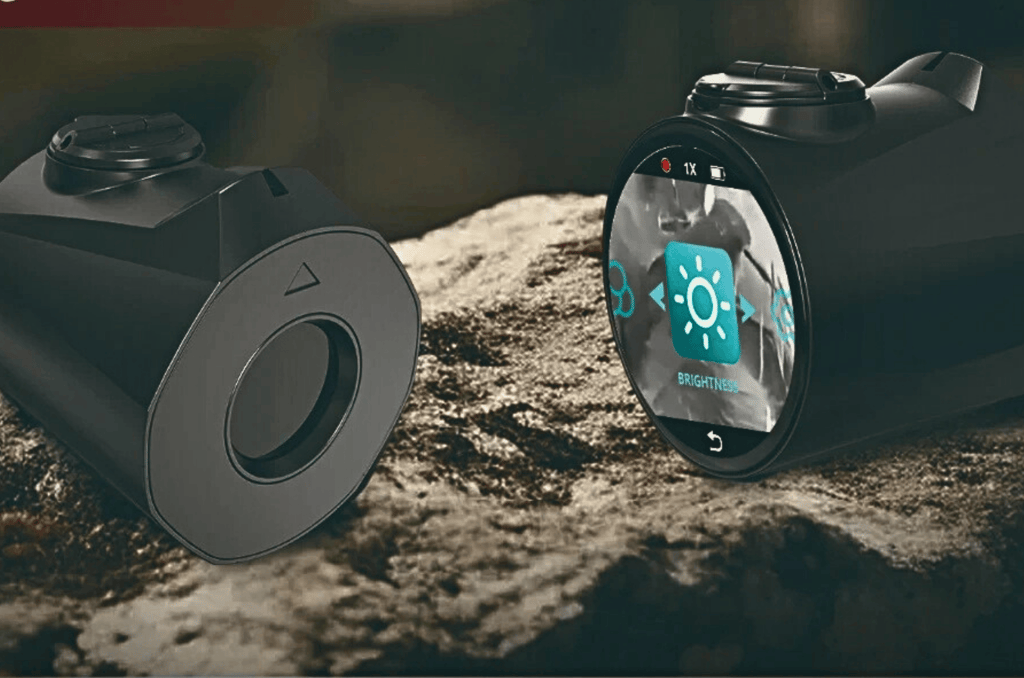
A new generation of compact thermal weapon sights has changed this format. The Tevin Sentinel S2 is built around a 256×192 sensor with 12µm pixel pitch, 25mK NETD, 60Hz refresh, and a 466×466 OLED display premium specs in every category that matters at four ounces. That weight number is what makes it practical to mount on a 45-degree offset without ruining a lightweight rifle's handling. Detection range is 500 meters, with 2x digital zoom for closer identification, and runtime is around 5 hours per battery.
Thermal Clip-On
For: shooters who already own a quality day scope and don't want to give it up.
Pros: keeps your existing zero, doesn't require re-learning a new optic, removable in seconds, daytime versatility unchanged.
Cons: longer optical train, typically heavier on the rail, premium price for premium models.
Clip-ons are how serious operators run thermal. The Breacher C1 thermal clip-on sits in front of your existing day scope, preserves your zero, and removes in under a minute when you don't need it. Same sensor specs as the S2 256×192, 12µm, 25mK, 60Hz paired with an 800×600 OLED display, the largest in this product class. Detection range extends to 1,000 meters, with up to 4x digital zoom. For a first thermal that integrates with a precision rifle you already own, this is the configuration that delivers without forcing you to rebuild the rifle around the optic.
Step Four: Set a Real Budget
Honest 2026 pricing tiers for your first thermal:
Under $1,000: Mostly digital night vision marketed as thermal, or genuinely entry-level thermal with poor pixel pitch (17µm typical), high NETD (50mK+), low refresh rate (30Hz), and basic LCD displays. The image quality and reliability aren't there. You'll be back shopping in six months.
$1,000-$1,500: Where most first-time buyers should land. The market in this band varies wildly. Most products at this price point still ship with 17µm pixel pitch, 40-50mK NETD, 30-50Hz refresh, and basic displays. A few Sentinel's S2 at $1,200 and Breacher C1 at $1,300 break that pattern with 12µm pitch, 25mK NETD, 60Hz refresh, and OLED displays. The right product at this price tier delivers what the market traditionally charged $2,500+ for.
$1,500-$2,500: Mid-tier. Still mostly 256×192 or some 384×288 sensors. Spec quality varies enormously. Premium pixel pitch and NETD start showing up consistently in this range from established brands. Worth comparing carefully a $2,200 thermal with 17µm pitch and 35mK NETD is being outperformed by a sub-$1,500 thermal with 12µm pitch and 25mK NETD, regardless of what the headline pixel count says.
$2,500-$4,500: Mid to upper-mid. 384×288 or 640×512 sensors become common, often paired with quality supporting specs. This is the bracket for buyers who need long-range identification or have specific tactical requirements.
$4,500-$8,000+: Premium. 640×512 sensors with premium everything across the board. Buy here when you've already done a season with mid-tier and know exactly what you want.
Important: don't blow your whole budget on the optic and forget the supporting gear. Budget for a quality mount ($150-$300), spare batteries, and ideally a basic NV monocular for navigation. A $2,000 thermal hanging off a $30 mount is a disaster waiting to happen.
Step Five: Avoid the Common First-Buyer Mistakes
A few patterns we see over and over.
Buying based on sensor pixel count alone. This is the biggest mistake in thermal shopping. A 384×288 sensor with poor pixel pitch, high NETD, and a basic LCD will be outperformed by a 256×192 sensor with premium pixel pitch, low NETD, and an OLED display. Every time. Read the full spec sheet, not just the headline.
Believing the marketing detection ranges. As we covered above, advertised detection ranges are nearly useless. Cut them by 60-75% to estimate real identification range.
Ignoring battery life and runtime. Some thermals advertise eight hours of runtime that's actually four hours when the sensor is working hard or the temperature drops. Look for user reviews of cold-weather runtime specifically. A real 5-hour runtime is more useful than a marketing-claimed 10 that doesn't survive contact with the field.
Skipping the warranty fine print. Thermal sensors are sensitive electronics. Drop, recoil failure, water ingress, sensor burn-in from staring at the sun — these are real failure modes. A "lifetime warranty" with twelve exclusions isn't a warranty. We built our Sentinel Covenant the way we did because we got tired of seeing the industry hide behind fine print.
Buying for the longest shot you might ever take. First-time buyers consistently over-spec for shots they'll never realistically attempt. If 95% of your shots happen inside 150 yards, buy for 150 yards, not 500. Save the difference for ammo, training, or a backup optic.
Step Six: Plan for Where This Is Going
Here's a truth that experienced operators understand and first-time buyers usually don't: your first thermal will not be your last thermal.
Plan for it. Buy something with quality specs at a reasonable price, use it for a year, and then make your second purchase with real-world experience instead of forum opinions. The buyer who tries to get the perfect thermal on the first attempt usually overpays, ends up with the wrong format, and is shopping again twelve months later anyway.
A smart first-buy progression looks like this:
Year one: Quality thermal with premium supporting specs at the $1,200-$1,500 range. Learn the technology. Find out what your property and use case actually demand.
Year two: Add a complementary format if you bought a weapon-mounted optic, add a handheld scanner. If you bought a clip-on, consider a dedicated lightweight option for offset use. The key insight from year one will tell you which.
Year three: Add complementary night vision for navigation and identification, if your use case justifies it.
This stair-step approach gets you in the game fast, keeps you from over-investing on bad assumptions, and ends up costing the same or less than trying to buy "the one perfect setup" up front.
What We'd Recommend for Your First Thermal
For a prepared citizen, rancher, or hunter buying their first thermal in 2026, the Tevin Sentinel S2 covers the use cases most people actually have. 12µm pixel pitch. 25mK NETD. 60Hz refresh. 466×466 OLED display. Four ounces. Pocketable as a handheld scanner. Mountable on a 45-degree offset for carbine use without compromising the rifle's handling. The supporting specs that actually drive image quality are at the level you usually only see at $2,500+.
If you already own a precision rifle with glass you trust, the Breacher C1 thermal clip-on lets you add thermal capability without changing anything about your primary setup. Same sensor specs as the S2, paired with an 800×600 OLED display — the largest in its class — and 1,000-meter detection range. Same zero. Same reticle. Thermal when you need it, removed when you don't.
Both undergo 100% QC inspection before shipping. Every unit. Not a sample. Not a percentage. That's the standard we hold ourselves to because we know what you're protecting.
Browse the full Sentinel Optics lineup to see how each system fits different missions, or reach out to us directly if you want a real conversation about what's right for your use case.
Your first thermal should be the start of a long working relationship with the technology not a regret you sell on a forum six months later. Buy smart. Buy once. Stand ready.
Sentinel Optics USA
Your loadout awaits. Explore our thermal systems and find your edge.
Contact
Newsletter
© 2026 All rights reserved.