✦ 100% QC Inspected ✦ Built for Protectors ✦ Backed by Our Covenant ✦
Load Development for the Precision AR-15: A 2026 Guide
A working reloader's guide to load development for the precision AR-15. Brass prep, charge weights, seating depth, and the process that finds your barrel's load.
PRECISION RIFLE GUIDES: RELOADING, BUILDS & LOAD DEV | SENTINEL
David Henry
5/8/20269 min read
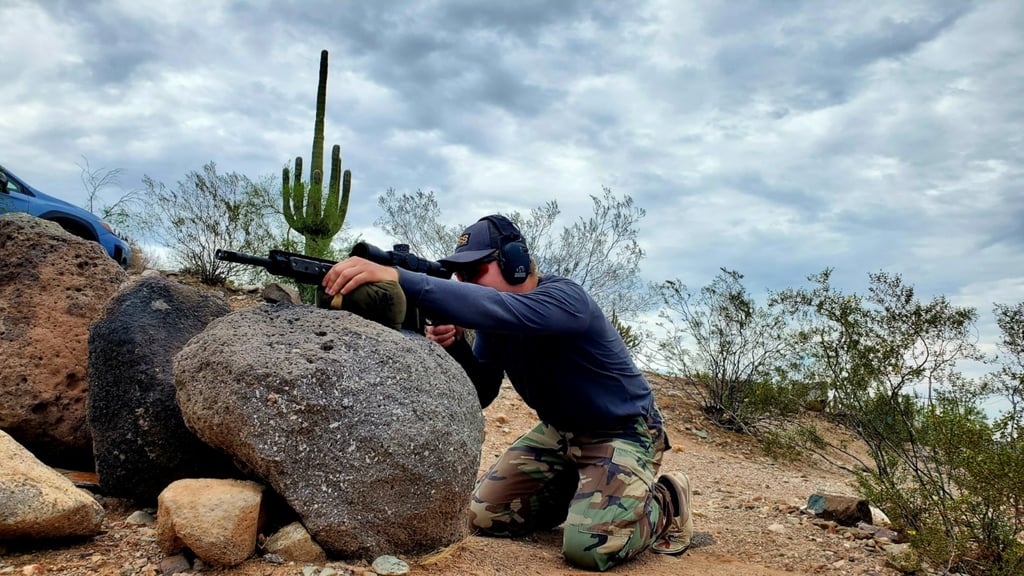
Load Development for the Precision AR-15: A Working Reloader's Guide
If you've built a sub-MOA AR-15 and you're still shooting factory ammunition, you've left a meaningful amount of accuracy on the table. A tuned handload for a specific barrel will outperform any factory match ammunition. Not by a little by enough to matter at the distances where precision actually shows up.
Load development is also where most reloaders get lost. The process is buried in tradition, conflicting advice, and YouTube videos from people who've never shot a five-shot group on paper. This guide cuts through it.
By the end, you'll have a repeatable process for finding the load your barrel actually wants not the load some forum poster ran in a different rifle five years ago.
What Load Development Actually Is
Load development is the systematic process of finding the combination of components and dimensions that delivers the smallest, most repeatable groups in your specific rifle. Not in someone else's rifle. Not in the manual's test rifle. Yours.
That distinction matters because every barrel is its own animal. Two rifles with identical specs from the same manufacturer can prefer loads that differ by a full grain of powder. The whole point of load development is finding what your barrel rewards.
The process has four steps:
Component selection
Brass preparation
Charge weight workup
Seating depth refinement
Skip any of them and you're not really doing load development — you're just hand-loading. There's a difference.
Step 1: Component Selection
Load development starts before you press a single primer. The components determine the ceiling of what you can achieve.
Brass
This is where most reloaders shortchange themselves. The brass is the chassis of the cartridge, and inconsistent brass means inconsistent loads, period.
For precision AR-15 work in 2026:
Lapua .223 the gold standard. Tightest tolerances available. Worth every penny if you're serious.
Starline .223 excellent quality, more available than Lapua, lower price.
Peterson premium domestic brass, very consistent.
Hornady Match good brass, solid mid-tier choice.
Lake City cheap, available, requires more prep but acceptable for working precision.
Mixed-headstamp range pickups are not load development brass. You can shoot them you can't develop a load with them and trust the results.
Buy a single lot of brass. Use it for the entire workup. When you go to a different lot, expect to verify your load.
Bullets
Match-grade bullets in the 69-77gr range are where the AR-15 really shines. The platform was never designed around the lightest pills, and the heavies open up new accuracy potential, especially at distance.
Top performers in 2026:
Sierra MatchKing 69gr and 77gr the workhorse. Forgiving, accurate, available.
Hornady ELD-Match 73gr and 75gr exceptional at distance, slightly less forgiving on seating depth.
Berger 73gr Boat Tail and 80.5gr Fullbore premium, demand careful tuning, reward it.
Nosler Custom Competition 69gr and 77gr solid alternative to Sierras.
Pick one or two bullets to start. Don't try to develop loads for four bullets simultaneously you'll burn barrel life and confuse the data.
Powder
For the 5.56/.223 case with match bullets, the proven powders are well established:
Varget the classic. Temperature-stable, accurate, consistent. Hard to find sometimes.
CFE 223 copper-fouling eraser, extruded, excellent accuracy potential.
H4895 slightly faster, very forgiving, great for heavier bullets.
N140 / N540 Vihtavuori's contribution, premium powder, premium price.
TAC Ramshot's option, ball powder, meters well from progressives.
For load development from scratch, Varget is hard to beat for 69-77gr bullets. If you can't find it, CFE 223 is the most accessible quality alternative. Don't try to develop loads with multiple powders at once. Pick one. Run it through the full process. Switch powders only after you've exhausted that one's potential.
Primers
For .223 in a precision AR, CCI BR-4 is the benchmark. Slightly lower variation than standard CCI 400s, hard cup that handles AR firing pin energy without slam-fires.
Acceptable alternatives: CCI 450 magnum (for ball powders, harder cup), Federal 205M, Remington 7½. Avoid Federal small rifle primers in semi-autos — softer cup increases slam-fire risk.
Stick with one primer for the full workup. Variation introduced by changing primers will destroy your data.
Step 2: Brass Preparation
This is the unglamorous work that separates serious handloads from pretty handloads.
Once-Fired Brass Workflow
If you're starting with once-fired brass (yours or purchased):
Tumble or wet-clean. Stainless pin tumbling produces the cleanest brass. Walnut/corn cob is faster but less thorough. Both work.
Decap. Universal decapping die before sizing keeps your sizing die clean.
Full-length resize. For semi-auto reliability, full-length size every firing. Set your die to bump the shoulder back .003-.005" from a fired case in your specific chamber. Use a comparator gauge don't eyeball it.
Trim to length. SAAMI max for .223 is 1.760". Trim to 1.750" or 1.755". Consistent trim length matters more than the specific number.
Chamfer and deburr. Inside and outside the case mouth. Light touch you're breaking the edge, not creating a funnel.
Clean primer pockets.
Anneal every 3-5 firings. Cartridge brass work-hardens. Annealing the neck and shoulder restores ductility and dramatically improves consistency. AMP makes the gold standard machine. A propane torch and a socket setup works for under $100.
New Brass
New brass also needs prep, even Lapua. Run it through a sizing die (or at least a neck sizing die), trim to consistent length, chamfer/deburr, . Skipping prep on new brass costs you accuracy you paid for.
Why This Matters
Inconsistent brass equals inconsistent neck tension, inconsistent shoulder bump, inconsistent case capacity, and inconsistent ignition. All of that shows up in vertical stringing on paper. The handload that shoots a 0.4 MOA group has carefully prepared brass behind it. The handload that shoots a 1.1 MOA group has whatever the brass came out of the cleaner looking like.
Step 3: Charge Weight Workup
This is where the actual development begins. The goal is to find the charge weight where your barrel exhibits its lowest velocity standard deviation and tightest grouping.
The OCW Method (Optimal Charge Weight)
OCW — also called the "ladder test" or "scatter node" approach is the workflow most precision shooters use. Here's the process:
Pick a load range. Start at a safe published starting load and end at or just below the published max. For a 77gr Sierra over Varget in .223 Wylde, that's typically 23.5gr to 24.8gr.
Load three rounds at each charge weight, in 0.2gr increments. So 23.5, 23.7, 23.9, 24.1, 24.3, 24.5, 24.7. Seven charge weights, twenty-one rounds total.
Use one seating depth for the entire test. Standard SAAMI OAL for the bullet, or .020" off the lands as a starting point. Seating depth comes later.
Shoot the test as a single string at 100 yards from a stable rest. Each five-shot group goes on a separate target. Use a chronograph for every shot.
Look for two things:
Group sizes that stay tight across multiple adjacent charge weights (this is your "scatter node" the velocity range your barrel likes)
Velocity SD under 15 fps, ideally under 10 fps
The tightest charge weight isn't always the right answer. The right answer is the center of a flat-grouping range a charge weight where 0.2gr in either direction still groups well. That's a robust load. A load that only shoots well at exactly one charge weight isn't a load it's a coincidence.
A Realistic Example
Recent test on an 18" .223 Wylde Criterion barrel with 77gr SMK over Varget:
23.5gr: 1.4" group, 2,710 fps avg, SD 18
23.7gr: 1.1" group, 2,735 fps avg, SD 14
23.9gr: 0.7" group, 2,758 fps avg, SD 9
24.1gr: 0.6" group, 2,778 fps avg, SD 8
24.3gr: 0.7" group, 2,795 fps avg, SD 11
24.5gr: 1.3" group, 2,815 fps avg, SD 16
24.7gr: 1.6" group, 2,830 fps avg, SD 22
The scatter node is clearly 23.9-24.3gr. Center the load at 24.1gr. That's where the barrel is happy and where small charge weight variations won't open up the group.
Pressure Signs
Watch every primer and case as you work up. Stop immediately if you see:
Cratered or pierced primers
Flattened primers (compared to the lower charge weights in the same string)
Heavy bolt resistance on extraction
Ejector swipes on the case head
Web expansion (measure case head diameter growth indicates pressure)
Published max loads exist for a reason. Don't push past pressure signs because someone on a forum says they run 25.0gr without issue. Their barrel, their chamber, their components are not yours.
Step 4: Seating Depth Refinement
Once you've nailed the charge weight, fine-tune the seating depth. This is where the last 20% of accuracy lives.
The Process
Find your lands. Use a Hornady OAL gauge, a Sinclair tool, or the wooden dowel method. Measure where the bullet first contacts the rifling for your specific bullet in your specific chamber. This number is unique to your rifle.
Set your starting depth. For most AR-15 magazines and bullet ogives, you'll be limited by magazine length anyway (2.260" SAAMI). Within that constraint, start with the bullet seated to give 0.020" jump (bullet 0.020" off the lands).
Test in 0.005" increments. Load three rounds each at jumps of 0.010", 0.015", 0.020", 0.025", 0.030", and 0.040". Use the optimal charge weight from step 3.
Shoot three-shot groups at 100 yards. You're looking for the seating depth where groups tighten noticeably.
Verify with five-shot groups. Pick the best two seating depths and load five rounds of each. Five-shot groups will tell you which one is the real winner versus a three-shot fluke.
Magazine Length Reality
The AR-15 magazine constrains you to 2.260" max OAL with most bullets. Some heavies will hit the lands before 2.260" — that's fine. Some (like the Sierra 77gr SMK) will be jumping a long way at 2.260" also fine, but those bullets sometimes prefer being seated longer in a single-feed precision configuration.
For magazine-fed precision AR work, accept the constraint and tune within it. For bench-only or single-feed shooting, you can experiment with longer OAL outside magazine constraints.
Step 5: Verification and Documentation
You found your load. Don't trust it yet.
Shoot multiple five-shot groups across multiple range sessions. A load that shoots 0.4 MOA on a calm Tuesday and 0.9 MOA on a windy Saturday isn't a 0.4 MOA load. It's a 0.7 MOA load with one good day in the data.
Verify across temperature. A load worked up at 75°F may show different velocity at 25°F or 95°F. If you'll shoot the load across a temperature range, verify across that range. Temperature-stable powders (Varget, RL15 Enduron, IMR 8208 XBR) reduce this concern but don't eliminate it.
Document everything. Powder lot, primer lot, brass lot, OAL, charge weight, seating depth, test conditions, group sizes, velocity averages, SD. Every variable. When you run out of components and have to switch to a new lot, your documentation is what lets you re-verify quickly instead of starting over.
A working load development log is a serious reloader's most valuable tool. It's the difference between knowing your rifle and guessing.
Common Mistakes That Cost You Accuracy
A few patterns we see repeatedly.
Three-shot group decisions. Three-shot groups are statistically meaningless. Five is the minimum for development decisions. Ten is better when you're verifying.
Skipping the chronograph. Group size is half the data. Velocity SD is the other half. A load with a 0.5 MOA group and 25 fps SD is not the same load as a 0.5 MOA group with 7 fps SD the first one will fall apart at distance, the second one will hold together. You need both numbers.
Changing variables simultaneously. New powder lot AND new bullet AND new primer? You have no idea what changed when groups open up. Change one variable at a time. Always.
Loading too many rounds before verification. Don't load 200 rounds of a "developed" load before you've shot at least 50 to verify it works across conditions. Two hundred rounds of an unverified load is two hundred rounds of components you might be pulling apart.
Ignoring the rifle's condition. A load that worked at round count 500 may not be the same load at round count 4,500. Barrels wear. Throats erode. As round count climbs, plan to re-verify your load periodically.
Pairing Your Handloads with the Right Optic
A precision rifle running tuned handloads deserves glass that can resolve what the load is capable of. We covered optic selection in the sub-MOA AR-15 build guide quality LPVO or higher-magnification scope, properly mounted, properly torqued.
For precision rifles that work both day and night predator hunters, working ranchers, prepared citizens the Breacher C1 thermal clip-on preserves your day optic and your hard-earned zero while adding full thermal capability. A precision rifle running tuned handloads behind a quality LPVO and a Breacher C1 is a serious working tool daylight precision out to whatever your data supports, thermal capability when the sun goes down, no compromise on either side.
The Bottom Line
Load development is process, not a recipe. The components matter, but the process matters more — careful brass prep, systematic charge weight workup with chronograph data, methodical seating depth tuning, honest verification across multiple range sessions.
Most reloaders skip steps and convince themselves their loads are tuned when they're really just hand-loaded. The shooters who actually do the work consistently report what every serious precision reloader will tell you: tuned handloads outperform every factory match ammunition you can buy. Not by a tiny margin — by enough to see on paper, every range trip.
If you want to talk through how thermal capability fits a precision rifle running tuned handloads, reach out. Or browse the Sentinel Optics lineup to see how each system fits a different mission.
Precision is a habit. Handloading is the most direct path to it. Stand ready.
Sentinel Optics USA
Your loadout awaits. Explore our thermal systems and find your edge.
Contact
Newsletter
© 2026 All rights reserved.