✦ 100% QC Inspected ✦ Built for Protectors ✦ Backed by Our Covenant ✦
Offset Mount vs Top Mount Thermal: Real-World Tradeoffs
Offset mount vs top mount thermal optics on a carbine — handling, weight, transition speed, and which setup actually works for your mission.
THERMAL OPTICS GUIDES: HUNTING, DEFENSE & BUILDS | SENTINEL
David Henry
5/17/20267 min read
Offset Mount vs Top Mount Thermal: Real-World Tradeoffs
You've decided to put thermal on your carbine. Good. Now comes the question nobody's review video answers honestly: where does it go?
Top mount feels like the obvious answer. That's where weapon sights live. Bolt it to the rail, zero it, run it. Done.
Except top-mounting a thermal on a defensive or hunting carbine has real costs — costs nobody talks about until you've spent four grand and realized your rifle now handles like a brick. The 45-degree offset mount has emerged as a serious alternative, and there are tradeoffs in both directions worth understanding before you drill the first screw in.
This is a working-shooter breakdown of when each setup actually wins.
The Two Setups, Briefly
Top mount: thermal optic sits directly on top of the upper receiver rail, on the bore axis, in the same place your day optic would go. Often replaces the day optic entirely, or stacks behind a magnifier or in front as a clip-on.
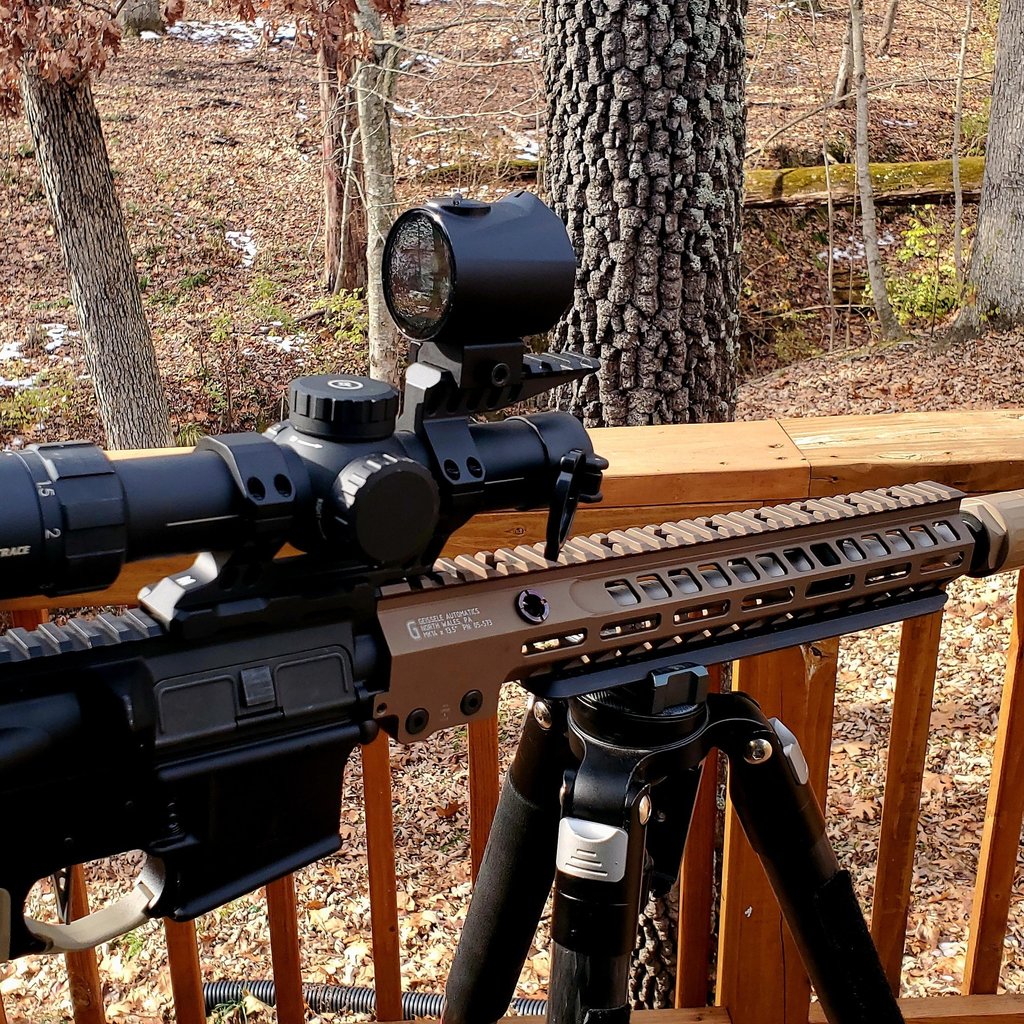
45-degree offset mount: thermal sits on a small picatinny section canted 45 degrees off the primary rail. Day optic stays on top in its usual position. Cant the rifle slightly to bring the thermal to your eye. Roll back to the day optic when you don't need thermal.
Both work. Both have legitimate use cases. The right answer depends on what you're trying to do.
When Top Mount Wins
Top mounting is the right answer when one of these is true.
You hunt at night, exclusively. If your rifle's only job is putting thermal-detected animals down at night, there's no reason to keep a day optic on the gun. Top-mount a quality thermal weapon sight, optimize the rifle around that one mission, and stop worrying about transitions. This is the predator hunter's classic setup and it works.
You shoot at distance through the thermal. Long-range thermal hunting — engagements at 200, 300, 400+ yards — demands stable, on-bore-axis optics. Magnification is critical. Stadia or MOA reticles need to be consistent with bore. Offset mounting at distance gets squirrely fast because cant errors compound with range.
Your rifle is purpose-built and dedicated. Some shooters run multiple uppers or multiple rifles. If one rifle is the thermal rifle, top mount it. If one rifle is the day rifle, glass it for day. Don't try to do both on the same gun.
You're using a clip-on. Thermal clip-ons (like the Breacher C1 we'll get to) live in front of an existing day scope, on the bore axis. They're top-mount by definition because they have to align with the day optic's optical centerline. This is a different beast than a standalone thermal weapon sight.
When Offset Mount Wins
The offset mount has gained traction for legitimate reasons. Here's where it actually beats top-mount.
Your rifle has more than one mission. Property defense, predator scanning, daytime shooting, occasional hunting — most working carbines aren't single-purpose. Offset mounting lets you keep a quality day optic (red dot, LPVO, prism) on top and have thermal capability available without swapping anything.
Most engagements happen inside 150 yards. At realistic property-defense and predator-call distances, the offset cant doesn't introduce meaningful error. You can engage through the thermal accurately. And inside 50 yards, in a yard with ambient light from a barn lamp or porch, your day optic with a weapon light will outperform thermal anyway. Offset gives you both.
You want fast detection, then conventional engagement. The realistic flow on a property defense rifle: cant the rifle, scan with thermal, find the threat, roll back to the day optic, engage with the optic optimized for the lighting condition. Offset is built for this transition. Top-mount thermal locks you into thermal-only shooting.
Weight and handling matter. This is the big one. A traditional thermal weapon sight is 12-24 ounces. Bolt it on top of a lightweight carbine and the entire balance of the rifle changes. The gun goes nose-heavy, becomes harder to drive between targets, and gets exhausting to carry on a long property scan. The right offset setup with a lightweight thermal can drop the weight penalty by half or more.
Your day optic is non-negotiable. Some shooters have a day optic they refuse to remove — a quality LPVO, a sentimental red dot, a zeroed prism. Offset preserves that completely. No re-zeroing, no swap, no compromise.
The Weight Problem Nobody Talks About
Let's go deeper on weight, because this is where offset mounting either makes sense or doesn't.
A typical thermal weapon sight runs 14-22 ounces. A typical thermal clip-on runs 12-18 ounces. Mount one of these as an offset and you're hanging well over a pound off the side of your handguard at a 45-degree angle. The leverage on the rail is brutal. The rifle's center of gravity shifts dramatically. Handling suffers.
This is why traditional offset thermal mounting got a bad reputation in the early 2010s. Shooters tried it with the heavy thermal weapon sights of the era and concluded that offset just doesn't work for thermal. Their conclusion was right for the thermals available at the time.
The market has changed. Lightweight, compact thermal optics designed specifically for offset and auxiliary mounting now exist. The Tevin Sentinel S2 thermal red dot weighs four ounces. That's not a typo and it's not marketing — it's an actual measured weight. At a quarter of the weight of a traditional thermal weapon sight, the offset math finally works. The rifle still handles like a rifle.
This is the category of optic that makes offset mounting practical for the first time. If you're trying to offset-mount a 16-ounce traditional thermal scope, the experience will frustrate you. If you're offset-mounting a four-ounce purpose-built thermal, you'll wonder why you didn't do it sooner.
The Transition: Practiced vs. Theoretical
A common argument against offset mounting is "the transition is slow." Here's the honest truth:
At first, yes. The first hundred reps feel awkward. You'll cant too much, you'll cant not enough, you'll forget which optic you're looking through. It's a new motor pattern.
After a few hundred reps, the transition becomes automatic. A trained shooter can roll between offset thermal and primary day optic in well under a second. It's a shoulder rotation combined with a slight head shift — not a full repositioning of the rifle.
The problem isn't the offset. The problem is people don't practice it. Shooters who run offset thermal report it feels natural after maybe two range sessions. Shooters who buy an offset thermal, mount it, and never train the transition complain about the speed forever.
If you're going to run offset, commit to fifty reps of the roll in your living room before your first real outing. Empty rifle, no ammo, no pressure. Just the motion. By the end of week one, you won't think about it anymore.
Cant Error and Realistic Engagement Distances
A real concern with offset mounting at distance: when the rifle is canted 45 degrees, your bore axis is no longer pointing where your sight picture suggests. At close range, the error is negligible. At distance, it grows.
Real numbers, with a 2.5-inch sight-over-bore offset:
25 yards: under 0.2" of error. Negligible.
50 yards: under 0.5" of error. Negligible for most uses.
100 yards: about 1.4" of error. Still inside vital zones for most game and threats.
200 yards: about 3" of error. Now it matters.
300 yards: about 4.5" of error. Significant.
For property defense, predator scanning, and the realistic engagement window most users actually face, offset is accurate enough. For long-range hunting, top-mount is the better choice.
This is the single most important practical question to ask yourself: where do my realistic shots happen?
If the answer is inside 150 yards, offset is on the table. If the answer is past 200 yards regularly, go top-mount.
Specific Setup Recommendations
Here's how we'd actually configure each option.
Offset Setup (Property Defense / General Purpose)
Carbine with quality day optic on top (red dot or LPVO)
45-degree offset rail section (Reptilia, Scalarworks, Arisaka all make good ones)
Lightweight thermal optic mounted on the offset section
Zero thermal at 50 yards
Practice the cant-and-roll transition
The Tevin Sentinel S2 was specifically designed for this configuration. Four ounces means the rifle's handling is preserved. The thermal red dot format means fast target acquisition without diving into a magnified thermal sight picture during dynamic engagement.
Top Mount Setup (Dedicated Night Hunting)
Dedicated thermal-only carbine or bolt gun
Quality top-mount thermal weapon sight
Sturdy single-piece mount or quick-detach mount
Zero at the distance you'll actually shoot
Spare batteries on the rifle or in a chest rig
Top Mount Clip-On Setup (Best of Both Worlds for Distance)
Quality day scope on top (LPVO or fixed power)
Thermal clip-on mounted in front of the day scope
Thermal preserves day optic zero — no re-zero needed
Removable in seconds for daytime use
The Breacher C1 thermal clip-on is built for this exact configuration. It runs in front of your existing day scope, preserves your zero, and gives you full thermal capability without committing the rifle to thermal-only operation. For shooters who already have quality glass and want thermal capability at distance, this is the most flexible setup available.
The Honest Recommendation
Most shooters don't actually need to choose. They need to be honest about what their rifle does.
Defensive carbine, property scanning, predator deterrence inside 150 yards: offset mount with a lightweight thermal. The Sentinel S2 was built for exactly this configuration.
Dedicated night hunting at distance, predator-only rifle: top-mount thermal weapon sight or a clip-on. The Breacher C1 is the right call if you want to keep your day scope.
Multi-purpose precision rifle that occasionally needs thermal capability: clip-on, top-mounted in front of your day scope. Best of both worlds, no compromises on day optic.
The mistake most first-time thermal buyers make is reading reviews from one camp (typically dedicated night hunters running top-mount) and assuming that setup is universally correct. It's not. It's the right setup for that mission. Different mission, different setup.
What We'd Tell You If You Called
We get this exact question from buyers every week. Here's the conversation, condensed:
What's your rifle for? If the answer involves daytime use or multiple mission profiles, offset is on the table. If the answer is "thermal only," top-mount.
What's your realistic max engagement distance? Under 150 yards favors offset. Over 200 favors top-mount.
What does your rifle weigh right now? Lightweight builds favor offset (with a lightweight thermal). Heavier precision builds can absorb a top-mount weight penalty.
Do you already own a day optic you trust? If yes, offset preserves it. Or use a clip-on that lets you keep using it directly.
There's no single right answer. There's a right answer for your rifle and your mission. We'd rather have you call us and talk it through than buy the wrong setup based on a YouTube video — reach out anytime. Or browse the full lineup at Sentinel Optics and see how each system fits a different role.
The dark belongs to the prepared. Configure your rifle for the mission it actually has. Stand ready.
Sentinel Optics USA
Your loadout awaits. Explore our thermal systems and find your edge.
Contact
Newsletter
© 2026 All rights reserved.