✦ 100% QC Inspected ✦ Built for Protectors ✦ Backed by Our Covenant ✦
The 12 O'clock Advantage: Running the Tevin Sentinel S2 on Your Coyote Rifle
Mount the Tevin Sentinel S2 at 12 o'clock on your diving board rail, scan for coyotes with thermal, then drop to your daytime optic and take the shot. Here's how.
THERMAL OPTICS GUIDES: HUNTING, DEFENSE & BUILDS | SENTINEL
David Henry
7/8/20267 min read
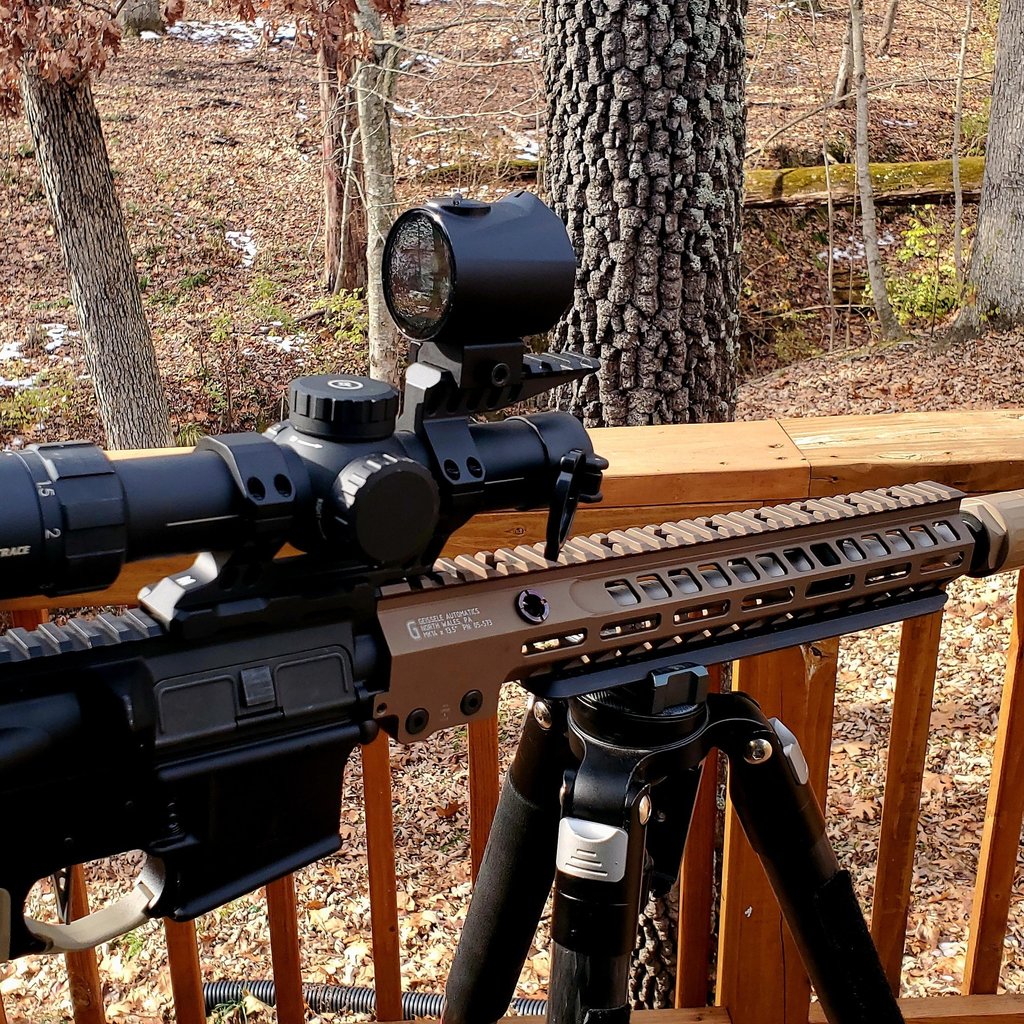
Here's a problem every serious coyote hunter runs into eventually: You know the animals are out there working the field edges after dark. Your thermal tells you exactly where they are. But the moment you try to take a precision shot through a thermal device, you're fighting the resolution limits of what that unit can actually deliver at 200 yards. Quality thermal imaging at long range costs serious money we're talking $5,000 and up for a dedicated thermal rifle scope capable of fine target discrimination at distance.
There's a better way to set up your rifle, and it's one I want to walk you through.
The Diving Board Setup What It Is and Why It Works
A diving board rail is a cantilever accessory rail that mounts at your 12 o'clock position, typically on your scope rings or a dedicated riser block, and extends forward over your scope to give you additional real estate above the rifle's bore axis. Some builders machine them into their rings. Others buy aftermarket versions from rail system manufacturers.
The purpose is simple: you gain a long, stable 12 o'clock mounting surface without interfering with the main optic below it.
In the precision rifle world, this setup has been used for years to run back-up iron sights, inclinometers, angle indicators, and small secondary optics above the primary scope. The idea translates perfectly to thermal and the Tevin Sentinel S2 is one of the very few thermal units light enough to make this setup genuinely practical.
Sub-five ounces. That's the key number. When you start adding weight that high above the bore axis, it affects your balance point and how the rifle settles between shots. At four ounces, the Tevin Sentinel S2 is adding next to nothing. You will not notice it is there when you're working a bipod and rear bag.
The Workflow in the Field
This is where the setup earns its keep, so let me walk through it step by step.
Step one: Scan. The sun's gone down. You're behind the rifle, set up in a ground blind or at the field edge, and you've got your night illumination going. You come up behind the Tevin Sentinel S2 which sits right above your eye line at 12 o'clock and glass the field. The three power magnification gives you enough reach to positively identify heat signatures at meaningful distances. You're looking for the glow of a coyote trotting the feed line, working the downwind edge, or cutting across open ground. The four color palettes on the Tevin Sentinel S2 let you dial in whatever helps you read the terrain white hot, black hot, or the contrast palettes depending on temperature differentials in your environment.
Step two: Identify. You've located an animal. You can see it clearly. You know what it is and roughly where it is in the field. Now you need to make a precision shot and that's not what you're asking the thermal to do. It has done its job. It found the animal in the dark. That's the task.
Step three: Drop to your daytime optic. This is where most people have an "aha" moment the first time they run it. You lower your chin slightly, shift your eye to your primary scope your high-end glass with the quality reticle you trust for precision work and the animal is right where the thermal told you it would be. Acquire your target. Your daytime scope is still functioning perfectly. You know exactly where the animal is in the field. The thermal removed the uncertainty.
Step four: Execute. You've got a confirmed target, you're in your precision optic, and you have the same holds and dope you've already verified at distance. The shot is a known quantity. Make it.
This workflow removes the single biggest problem in low-light hunting: not knowing where to look. The thermal tells you where to look. Your precision scope tells you where to aim.
Why This Is Better Than a Dedicated Thermal Rifle Scope for Most Hunters
I want to be straight with you here, because I think a lot of gear articles oversell the "just buy a thermal rifle scope" solution without talking through the tradeoffs.
A quality dedicated thermal rifle scope capable of making a 200-yard precision shot on a coyote-sized target costs somewhere between $4,500 and $10,000 depending on the platform and resolution. The detection and identification ranges are genuinely excellent on the top-tier units. If you're running a high-volume predator calling operation and you're shooting upward of 100+ animals a year, that investment may make sense.
But for the hunter who wants thermal capability on their precision rig without completely rebuilding their budget? The Tevin Sentinel S2 on a diving board rail is less than $1200 depending on configuration and it gives you the full detection and identification benefit of quality thermal technology while letting your existing glass do what it does best: deliver a clean, precise aiming solution.
You're also not locked in. The Tevin Sentinel S2 dismounts in seconds. Tonight it's on your coyote rig. Saturday morning it's handheld while you're glassing for hogs before the light comes up. Monday it's back on your carbine for a home property check. That versatility is part of what makes it worth owning.
Running Three Power Magnification the Right Way
The Tevin Sentinel S2 now runs up to three power magnification, which opens up real reach when you're glassing from a fixed position. Here's how I'd approach using it at the different power levels in a field scanning scenario:
At one power, you're getting your broadest field of view. This is your default scanning mode wide coverage, fast acquisition, you're trying to find heat signatures anywhere in the area.
At two power, you've spotted something and you're trying to get a cleaner look. Is that a deer or a coyote? Is that one animal or two? This is your identification power.
At three power, you've got a confirmed target and you want to assess the situation before you transition to your primary optic. Range is still tight enough that the unit is giving you a solid image, and you can call the shot.
Work through those magnifications in sequence and you've got a complete scan-to-identify workflow in one device.
Color Palette Notes for the Precision Rifle Setup
The four color palettes on the Tevin Sentinel S2 each have different strengths in a scanning application at night. Here's my general read:
White Hot is the most intuitive for most people. Warm bodies appear bright against the cooler environment. Easy to process quickly when you're scanning a field.
Black Hot flips the presentation. Some hunters find it easier to pick up moving targets against open backgrounds in black hot, particularly if the ground has significant temperature variation.
The contrast palettes (the color options) give you the clearest differentiation between temperature gradients. If you're hunting terrain with a lot of thermal clutter warm rocks, disturbed ground, vehicle heat signatures a color palette can help you sort signal from noise faster.
Honestly, try all four in your actual hunting environment. What works on open wheat stubble may not be your first choice in cedar country. The fact that you can switch between them on the fly is one of those small features that turns into a real advantage in the field.
Mounting Considerations on a Bolt Gun
A few practical notes for anyone building this setup:
Your scope rings need to have either an integrated diving board rail or a provision for one. Many quality precision rings from manufacturers like Spuhr, Nightforce, and similar offer accessory rail options.
Position the Tevin Sentinel S2 far enough forward on the diving board that it doesn't interfere with your normal cheek weld, but not so far forward that you're reaching for it when you're scanning. A natural eye-relief position on the diving board is different from your scope's eye-relief position, and you'll find it by cheek welding normally and seeing where your eye naturally falls above the scope.
The Tevin Sentinel S2's compact form factor helps here considerably. It's not asking for a lot of rail space, and it sits low enough that transitioning between the thermal and your primary optic is a small, natural movement rather than a full repositioning.
The Honest Case for Running This Setup
I'm not going to tell you the Tevin Sentinel S2 on a diving board rail replaces a $7,000 thermal rifle scope. It doesn't. The dedicated thermal rifle scope has advantages in final identification and aiming that are real.
What I will tell you is that for the majority of hunters people calling coyotes out to 200 yards on reasonably open ground, predator hunters working ag fields, guys running precision rigs who want to add a thermal detection capability without turning their $3,000 rifle into a $10,000 platform this setup outperforms the alternatives on every practical axis.
It weighs next to nothing. It doesn't shift your balance point. It comes off in seconds. It detects and identifies everything a dedicated thermal rifle scope detects and identifies. And your precision glass still gets to do the precision work.
The Tevin Sentinel S2 is available at Sentinel Optics USA. If you're setting up a precision coyote or predator hunting rig and you want to talk through the mounting configuration, reach out through our contact page I'm happy to walk through it with you.
FAQ
Can I mount the Tevin Sentinel S2 at 12 o'clock on any precision rifle? You need a diving board rail or a similar 12 o'clock mounting surface above your primary scope. Many quality scope rings support this with accessory rail mounts. If your current rings don't, it's worth looking into ring options that do before investing in a new rail system — often the most economical path.
What magnification does the Tevin Sentinel S2 run at for 200-yard coyote detection? The Tevin Sentinel S2 offers up to three power magnification. For 200-yard identification of coyote-sized targets, two to three power is your working range. At 100 yards, you have all the identification capability you need at any magnification.
Do I need to rezero my primary scope when I add a Tevin Sentinel S2 to the diving board? No. The Tevin Sentinel S2 is a secondary scanning device it has no effect on your primary optic's zero. Your scope sits untouched in its rings, zeroed exactly where it was before.
Does the Tevin Sentinel S2 work in rain and fog? Thermal imaging is largely unaffected by light rain and fog in a way that white light cannot match. Thermal reads heat differentials, not reflected light. Heavy precipitation reduces performance in any optic system, but light to moderate weather conditions are significantly less limiting for thermal than for conventional glass.
Is three power magnification enough to replace a spotting scope for daytime glassing? The Tevin Sentinel S2 is a thermal imaging device and is not designed for daytime use. For daytime glassing, your conventional spotting scope or binoculars are the right tools. The Tevin Sentinel S2 earns its place after dark.
Sentinel Optics USA
Your loadout awaits. Explore our thermal systems and find your edge.
Contact
Newsletter
© 2026 All rights reserved.