✦ 100% QC Inspected ✦ Built for Protectors ✦ Backed by Our Covenant ✦
Thermal Scope vs Night Vision: Which Do You Need in 2026?
Thermal scope vs night vision in 2026: an honest breakdown for predator hunting, homestead defense, and tactical use — from Sentinel Optics USA.
THERMAL OPTICS GUIDES: HUNTING, DEFENSE & BUILDS | SENTINEL
David Henry
5/4/20268 min read
Thermal Scope vs Night Vision: Which Do You Actually Need in 2026?
You've got a coyote problem. Or a hog problem. Or a peace-of-mind problem. Either way, you've spent the last three nights down a rabbit hole of YouTube reviews, forum arguments, and product pages with prices that made you slam the laptop shut. Thermal scope vs night vision which one actually solves your problem?
Here's the honest answer most companies won't give you: they're not the same tool, they don't do the same job, and the question itself is slightly wrong. The real question is what are you trying to accomplish in the dark?
We're going to walk through that straight, no marketing fog and by the end you'll know exactly which one (or both) belongs on your rifle and on your head.
The Fundamental Difference (In Plain English)
Strip away the spec sheets and you're left with one core distinction.
Night vision amplifies light. It takes the tiny amount of starlight, moonlight, or distant ambient light hitting the lens and electronically multiplies it until your eye can see a usable image. No light at all? You need an IR illuminator (basically a flashlight your eyes can't see but the device can). The image looks like the world just green, white-phosphor, or grayscale depending on the device.
Thermal sees heat. Every object above absolute zero radiates infrared energy. A thermal sensor reads that energy and paints a picture of temperature differences. Warm coyote against cool grass? Glows like a flare. The image doesn't look like the world it looks like a heat map. You're not seeing detail; you're seeing thermal contrast.
That single distinction drives everything else.
Where Thermal Wins (And By How Much)
Thermal optics are the right answer when your job is detection finding something that's hiding, moving, or trying not to be seen.
Tall grass, brush, and tree lines. A bedded coyote is functionally invisible to night vision. Same coyote on thermal? You'll spot it from 200 yards, no question. This single capability is why thermal has taken over predator hunting in the last decade.
Total darkness. Cloudy, moonless, deep woods, no IR illuminator? Night vision struggles. Thermal doesn't care there's no ambient light requirement at all. Pitch black is the same as twilight to a thermal sensor.
Light smoke, fog, and dust. Thermal cuts through atmospheric obscurants better than night vision. Not perfectly heavy fog will defeat anything but in the kind of haze you actually deal with on a working property, thermal keeps working when NV gets washed out.
Day use. This surprises people. Modern thermal works just as well in daylight as it does at night, because it's not reading visible light at all. Scanning a tree line at dusk for a wounded deer? Thermal. Scanning a hayfield for hogs at noon? Also thermal.
Blood trails and wounded game. Warm blood lights up on thermal for 20-30 minutes after a shot. Walking up to a downed animal in the dark? Thermal tells you immediately whether it's still alive.
Where Night Vision Wins (And You'd Be A Fool To Ignore It)
Night vision optics are the right answer when your job is identification or navigation recognizing what something is, or moving through terrain without breaking your neck.
Detail and recognition. This is the big one. A thermal image tells you something warm is there. Night vision tells you that's a 200-pound boar with two piglets, and there's a fence post six feet to its left. You can read a face on quality NV. You cannot read a face on thermal. For any situation where positive identification matters and every defensive situation does NV is the answer.
Through glass. Thermal cannot see through glass. Period. The glass blocks infrared. If you need to scan from inside a vehicle or through a window, night vision is your only option.
Walking and depth perception. Try walking through unfamiliar woods with only a thermal monocular. You'll trip in thirty seconds. Thermal flattens depth and washes out terrain detail. Night vision preserves depth perception, contrast, and the visual cues your brain uses for movement.
Reading maps, tools, and equipment. Anything with a uniform temperature a paper map, a phone screen at night, the controls on a UTV disappears on thermal but reads fine on NV.
Cost at the entry level. A capable digital night vision monocular starts around $400-$800. A capable thermal monocular starts closer to $1,200. If budget is the limiting factor and you mostly need to navigate or watch from a fixed position, digital NV gets you in the game faster.
The Cost Reality in 2026
Let's talk numbers, because every other comparison article dodges this. The thermal market has shifted significantly in the last two years what cost $2,500 in 2023 can be had today, with better specs, for under $1,500. Pricing alone no longer tells you what you're getting.
Thermal in 2026:
$1,000–$1,500: Where the value disruption is happening. Most products in this band still ship with legacy 17µm pixel pitch, high NETD (40-50mK), and basic LCD displays. A few including Sentinel's Tevin S2 at $1,200 and Breacher C1 at $1,300 — deliver premium 12µm pitch, 25mK NETD, 60Hz refresh, and OLED displays. The right product at this price tier delivers what the market traditionally charged $2,500+ for.
$1,500–$2,500: Mid-tier. Spec quality varies enormously. A $2,200 thermal with 17µm pitch and 35mK NETD is being outperformed by a sub-$1,500 thermal with 12µm pitch and 25mK NETD, regardless of headline pixel count. Read the full spec sheet, not just the sensor resolution.
$2,500–$4,500: Mid to upper-mid. 384×288 or 640×512 sensors become more common, often paired with quality supporting specs. This is the bracket for buyers who need long-range identification or specific tactical features.
$4,500–$8,000+: Premium. 640×512 sensors with premium everything across the board.
Night vision in 2026:
Digital night vision: $400–$1,500 (works well in moderate light, limited in true dark)
Gen 2+ analog tubes: $1,500–$3,000 (decent, mostly being phased out)
Gen 3 white phosphor (the gold standard): $3,500–$8,000+ per tube
PVS-14 monocular with quality Gen 3 tube: ~$3,500–$5,000
The gap that existed five years ago — where thermal was way more expensive than NV has closed dramatically. A capable thermal optic today can be had for less than half the price of a quality Gen 3 NV monocular. The decision is no longer mostly about money. It's about what you actually need to do.
What Serious Operators Actually Run
Here's the dirty secret of every professional unit, every experienced predator hunter, and every prepared citizen with real night experience: they run both.
Thermal on the rifle (or as a clip-on or handheld for scanning). Night vision on the head for navigation and identification. Detect with thermal, identify with NV, engage with the appropriate optic for the conditions.
You don't have to start there. But understanding that thermal and NV are complementary not competing will save you from buying the wrong tool first and having to re-buy six months later when you realize what you actually needed.
So Which One Do You Actually Need?
Real recommendations by use case.
For predator and hog hunting on rural property: Start with thermal. It's not even close. The detection advantage in tall grass, tree lines, and brush makes thermal the single highest-impact piece of gear for this use case. A handheld thermal monocular plus a thermal weapon sight (or a thermal clip-on in front of your day scope) covers ninety percent of the realistic shots you'll take.
For homestead and livestock defense: Start with thermal, same reasoning. The threats coyotes, hogs, the occasional two-legged trespasser are almost always trying to hide or move undetected. Thermal finds them. Once located, you close distance and use your day optic, weapon light, or a secondary NV device for positive identification before any decision to engage.
For navigating and patrolling at night: Night vision. Period. You cannot safely move through unfamiliar terrain on thermal alone. If your job description involves walking, scanning, and clearing not just sitting and watching head-mounted NV is non-negotiable.
For home defense in a structured environment: This is more nuanced. If you live somewhere with ambient light spillage from streetlights, NV (or even just a good weapon light) will outperform thermal for shot placement at typical home-defense distances. If you're rural and dark, thermal still wins.
For agency and tactical use: Both. Always both. The mission dictates the configuration.
The Mistakes People Make
A few patterns we see repeatedly from buyers calling us.
Buying based on sensor pixel count alone. This is the biggest mistake in thermal shopping. A 384×288 sensor with poor pixel pitch (17µm), high NETD (50mK), and a basic LCD will be outperformed by a 256×192 sensor with premium pixel pitch (12µm), low NETD (25mK), and an OLED display every time, in every realistic condition. The headline pixel count is a tier-one marketing number; it's a tier-three performance number. Read the full spec sheet.
Buying digital NV and expecting Gen 3 performance. Digital night vision has come a long way, but in true dark conditions it falls apart. If you're in a moonless rural environment, digital NV without an IR illuminator is barely usable. And the moment you turn that illuminator on, you've made yourself visible to anyone else with NV. That's a tradeoff worth thinking through.
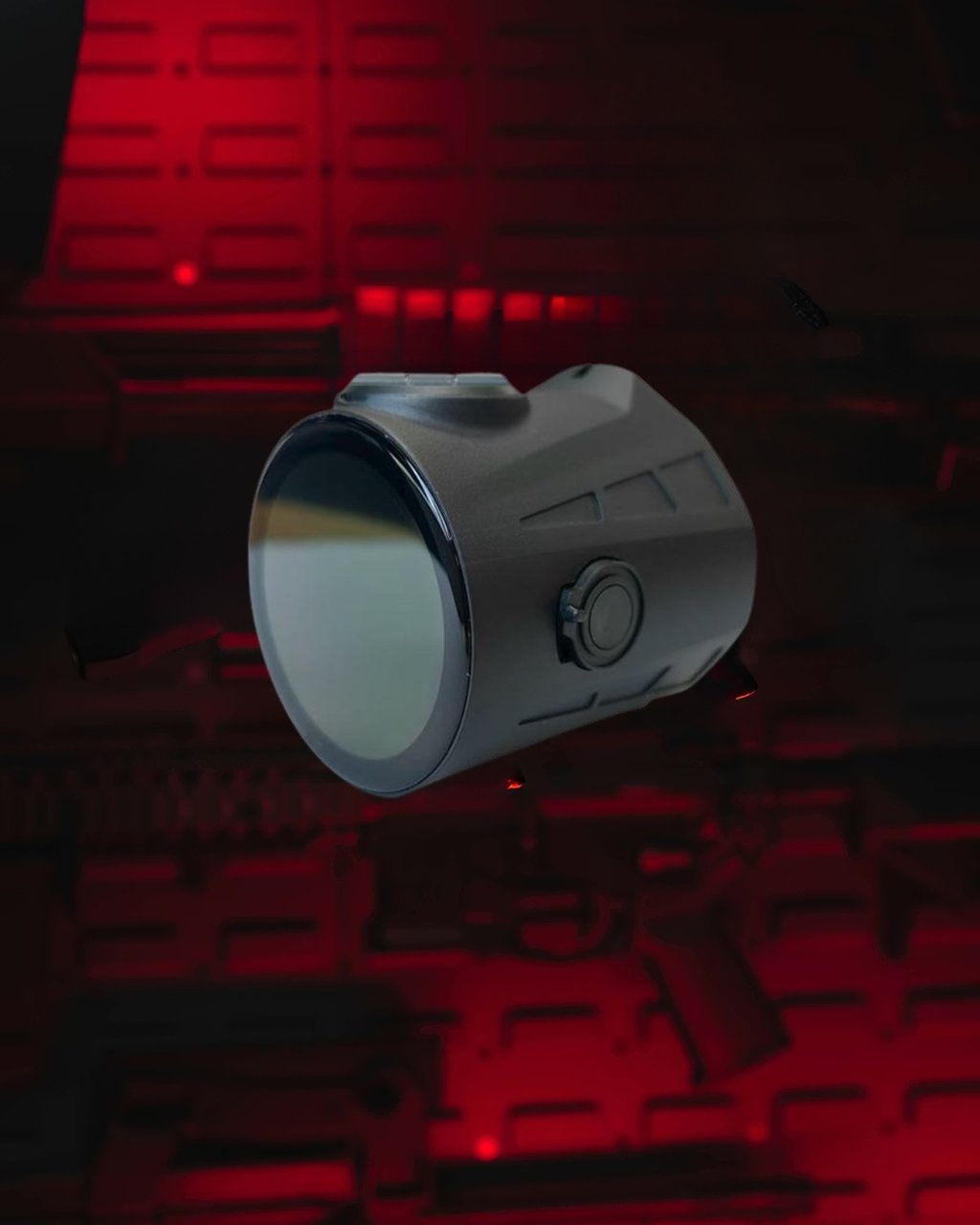
Mounting a thermal scope without a backup. Thermals are electronic. Batteries die, sensors fail, cold weather does weird things. Mounting a thermal as your only optic on a defensive rifle is a single point of failure. This is exactly why we built the Breacher C1 it's a clip-on that runs in front of your existing day scope, so if the thermal goes down, you still have a fully functional rifle with its original zero.
Ignoring weight on the rifle. Most traditional thermal weapon sights run twelve to twenty-four ounces. Hang that on a lightweight build and you've ruined the handling the gun goes from nimble to nose-heavy in a single accessory. The four-ounce Tevin Sentinel S2 was specifically engineered around this problem, and it's why offset mounting finally works as a practical configuration.
If You're Protecting Your Homestead After Dark, Here's What We Recommend
For most prepared citizens, ranchers, and homesteaders walking into this from scratch, the priority order is straightforward.
Start with thermal. It solves the detection problem which is the actual problem you have. You don't have a "I can't identify what I'm seeing" problem; you have a "I can't see anything in the first place" problem. Thermal fixes that.
The Tevin Sentinel S2 is built around the specs that actually drive image quality 12µm pixel pitch, 25mK NETD, 60Hz refresh, and a 466×466 OLED display at four ounces and $1,200. Light enough to live in a pocket or on a 45-degree offset mount without compromising your rifle's handling. 500-meter detection range, 2x digital zoom, 5-hour runtime. Pull it out for a perimeter scan, run it on your carbine when it matters, put it back when it doesn't. See beyond the dark without rebuilding your rifle around the optic.
If you already have a quality day scope and want to add thermal capability without changing your primary setup, the Breacher C1 thermal clip-on mounts in front of your existing optic. Same premium thermal foundation as the S2 12µm pitch, 25mK NETD, 60Hz refresh paired with the largest display in its class: an 800×600 OLED. 1,000-meter detection range, up to 4x digital zoom, $1,300. Same zero. Same reticle. Thermal capability when you need it, removed in seconds when you don't. No single point of failure on a defensive rifle.
Then add night vision once you've used thermal for a few months and understand where the gaps actually are for your property and your use case, you'll know exactly what kind of NV setup fits. We'd rather have you make that decision from experience than from a forum thread.
Both Sentinel products are 100% QC inspected before they ship. Every unit. No exceptions. That's the Sentinel Covenant: if it doesn't meet our standard, it doesn't leave our facility. Browse the full lineup at our shop page or learn more about who we are and what we build.
The dark stops being something that happens to you and starts being something you operate in.
Stand ready. Stand vigilant. Stand with Sentinel.
Sentinel Optics USA
Your loadout awaits. Explore our thermal systems and find your edge.
Contact
Newsletter
© 2026 All rights reserved.