✦ 100% QC Inspected ✦ Built for Protectors ✦ Backed by Our Covenant ✦
Three 22 ARC Barrels, One Powder, and a 70 FPS Gap That Never Moved
What does a factory cold hammer forged barrel give up to a premium cut-rifled barrel at the same 20-inch length? I finally have a real answer. Over six range sessions from February through April 2026, I ran a Ruger American Prairie, a custom Falkor Defense build with a 20-inch Proof Research carbon fiber barrel, and a custom AR-15 with a 16-inch Proof Research stainless barrel side by side — all loaded with Shooter's World Precision powder, all through the same chronograph, with six different bullet weights from 62 to 88 grains. The Proof Research carbon barrel ran 70 fps faster than the Ruger every single session. The Ruger ran faster than the 16-inch AR — but that gap moved considerably depending on the load, and the reason why has everything to do with how a gas gun uses its propellant. This is the barrel comparison nobody has run in 22 ARC. Now you have the data.
PRECISION RIFLE GUIDES: RELOADING, BUILDS & LOAD DEV | SENTINEL
David Henry
4/29/20266 min read
Field Report · Ballistics · 22 ARC
Hammer Forged vs. Cut Rifle:
What 22 ARC Does Across Three Barrels
Seven range dates, three rifles, one cartridge and a consistent ~70 fps manufacturing advantage that showed up every single session.
Field Data: Feb 28 – Apr 3, 2026 · 62 gr / 77 gr / 85.5 gr / 88 gr
There's a recurring argument in precision rifle circles about whether barrel manufacturing method actually matters for velocity or whether it's the kind of thing that sounds good on paper but vanishes in real-world data. We had a rare opportunity to test that theory empirically: three rifles chambered in 22 ARC, shot side by side across six range dates spanning February through April 2026, with results logged shot-for-shot through a chronograph. The findings are cleaner than we expected.
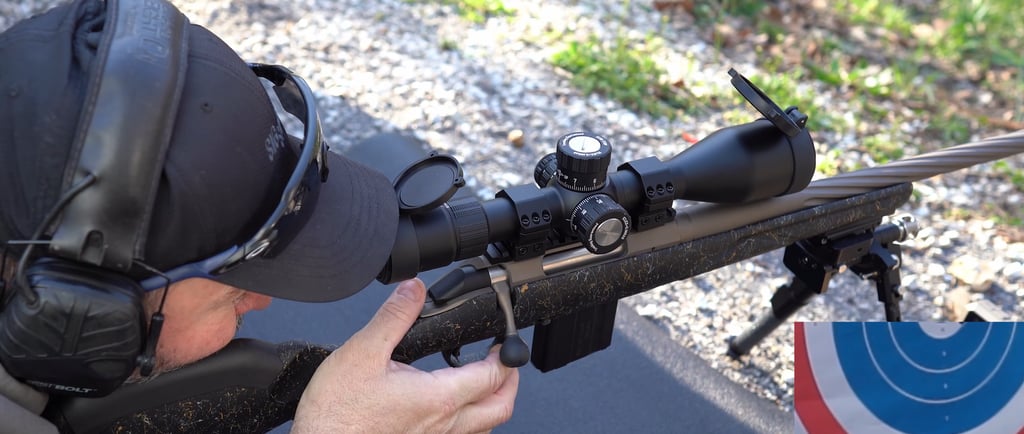
The three subjects: a factory Ruger American Prairie with a 20-inch hammer-forged barrel, a full custom build on a Falkor Defense action wearing a 20-inch Proof Research carbon-fiber wrapped cut-rifled barrel, and a custom AR-15 with a 16-inch Proof Research stainless cut-rifled barrel. Each range session ran all three rifles back to back, five shots per string, on the same ammunition. Here's what the data actually says.
Rifle A — Slowest Each Session
Custom AR-15
Proof Research Stainless
16" cut-rifled barrel · Stainless steel
AR-15 platform
Rifle B — Middle Each Session
Ruger American Prairie
22 ARC
20" hammer-forged barrel · Factory production
Bolt action
Rifle C — Fastest Each Session
Falkor Defense Custom
Proof Research Carbon
20" cut-rifled barrel · Carbon-fiber wrapped
Full custom build
The Complete Dataset
Six outings, three rifles each time. Within every session, the rank order never changed: the 16-inch AR was always slowest, the 20-inch Ruger always second, the Proof Carbon 20" always fastest. The margins varied by load and conditions, but the hierarchy was ironclad across every bullet weight tested.
Date
Bullet
AR-15 16" Proof SS
(Cut Rifle)
Ruger 20"
(Hammer Forged)
Proof Carbon 20"
(Cut Rifle)
Carbon
vs Ruger
Ruger
vs AR
Feb 28
62 gr
3,076.0
3,147.3
3,216.9
+69.6 fps
+71.3 fps
Mar 6
77 gr
2,917.2
2,945.6
3,037.3
+91.7 fps
+28.4 fps
Mar 14
77 gr
2,779.1
2,815.2
2,903.4
+88.2 fps
+36.1 fps
Mar 22
85.5 gr
2,657.2
2,667.1
2,744.0
+76.9 fps
+9.9 fps
Mar 28
88 gr
2,655.9
2,715.5
2,779.6
+64.1 fps
+59.6 fps
Apr 3
70 gr Barnes TAC-TX
2,694.1
2,748.2
2,790.5
+42.3 fps
+54.1 fps
Overall Averages
2,796.6
2,839.8
2,911.9
+72.1 fps
+43.2 fps
All velocities are 5-shot session averages. Rifle assignment confirmed by shooter: within each date, slowest = AR-15, middle = Ruger, fastest = Proof Carbon.
+72 fps
Proof Carbon vs Ruger
avg across all sessions
+43 fps
Ruger vs AR-15
avg across all sessions
+115 fps
Proof Carbon vs AR-15
avg across all sessions
The Headline Finding: ~70 fps Per Manufacturing Tier
"The cut-rifled Proof Carbon barrel ran approximately 70 fps faster than the hammer-forged Ruger at the same 20-inch length — every single session, every bullet weight."
The Carbon vs. Ruger gap is the most consistent number in the entire dataset. Across six outings covering four different bullet weights, it ranged from a low of +42 fps to a high of +92 fps, averaging out to +72 fps. That consistency across different temperatures, loads, and days tells you this is a real and repeatable phenomenon not session-to-session noise.
The Ruger vs. AR gap is more load-dependent. With 62 gr bullets it nearly matched the manufacturing gap at +71 fps. But with heavier 77 gr projectiles it compressed to just +28–36 fps, and with the 85.5 gr load it nearly collapsed to a statistical whisper of +9.9 fps. This behavior makes physical sense: with slower-burning powders and heavier bullets, a 16-inch barrel starts losing efficiency more rapidly, but that effect is load-specific. With the right 22 ARC load, the short AR platform can nearly close the 4-inch length gap against the Ruger.
62 gr — Feb 28, 2026 (Cleanest Equal-Load Comparison)
Proof Carbon
20" Cut Rifle
3,216.9 fps
Ruger Prairie
20" Hammer Forged
3,147.3 fps
AR-15
16" Proof SS Cut
3,076.0 fps
77 gr — Mar 14, 2026
Proof Carbon
20" Cut Rifle
2,903.4 fps
Ruger Prairie
20" Hammer Forged
2,815.2 fps
AR-15
16" Proof SS Cut
2,779.1 fps
88 gr — Mar 28, 2026
Proof Carbon
20" Cut Rifle
2,779.6 fps
Ruger Prairie
20" Hammer Forged
2,715.5 fps
AR-15
16" Proof SS Cut
2,655.9 fps
Why Does Manufacturing Method Move the Number?
Hammer forging drives a tungsten carbide mandrel through the bore while hammering the blank from the outside, cold-working the rifling into the steel in a single rapid operation. It's efficient, produces extremely durable barrels, and the compressed grain structure genuinely hardens the steel. Ruger has refined this process for decades, and it shows the Prairie is a legitimately capable factory barrel. But there are limits to what the process can achieve in terms of bore consistency and surface finish across the full length of the tube.
Cut rifling removes steel one pass at a time with a single-point cutter. It's slow, expensive, and demands skilled barrel-making but it allows the craftsman to hold bore diameter tolerances and surface finishes that hammer forging simply can't match. A tighter, smoother bore means less gas escapes past the projectile during the pressure event. More gas energy goes into acceleration. Over a 20-inch barrel, that efficiency advantage compounds into the 70+ fps delta we're measuring here.
The Proof Research carbon-fiber wrap adds another dimension: the carbon composite dissipates heat differently than a steel contour barrel, helping the barrel maintain consistent temperature across a shooting session. That thermal stability contributes to the tight standard deviations visible throughout the dataset this barrel doesn't just shoot fast, it shoots consistently fast.
Projecting Intermediate Barrel Lengths
With measured data anchoring us at 16" and 20", we can project intermediate lengths with reasonable confidence. Our data suggests the 22 ARC in this pressure and load class yields approximately 17–18 fps per inch of barrel derived from the February 28th 62 gr session, which gives us the cleanest equal-load comparison across all three rifles.
The ~70 fps cut-over-hammer-forged advantage is held constant across the table below. Whether that premium compresses slightly at shorter barrel lengths is unknown, but 72 fps is the best number we have from six sessions of real data.
Barrel Length
Cut Rifled
(AR Platform)
Hammer Forged
(Bolt Action)
Cut Rifled
(Premium)
Notes
14.5"
~3,008
~2,940
~3,010
SBR / pinned muzzle device
16"
3,076 ★
~3,009
~3,079
AR-15 Proof SS — actual measured data
18"
~3,111
~3,079
~3,149
An 18" cut barrel likely matches the Ruger 20" HF
20"
~3,145
3,147 ★
3,217 ★
Ruger HF and Proof Carbon — actual measured data
22"
~3,179
~3,181
~3,251
Diminishing returns beginning; ideal long-range bolt length
24"
—
~3,215
~3,285
Maximum practical gains; powder mostly spent by this point
★ = actual measured data (62 gr load, Feb 28). All other values are estimates using ~17 fps/inch interpolation with the ~70 fps cut-rifled premium held constant. Real-world results vary by load, powder, temperature, and chamber dimensions.
The most interesting number in that table: an 18-inch cut-rifled barrel is projected to essentially match the 20-inch Ruger's actual velocity. If you're building a more compact precision bolt gun, a quality 18-inch cut barrel likely gives you Ruger 20" performance and a premium cut-rifled 18" gets you close to the full Proof Carbon 20" number. That's a meaningful trade for anyone prioritizing portability.
The 85.5 gr Anomaly — Mar 22
One session stands out and deserves an honest mention rather than being smoothed over. On March 22nd shooting 85.5 gr bullets, the gap between the Ruger and the 16-inch AR nearly vanished just 9.9 fps separated them, compared to the 43 fps session average. The most likely explanation is powder burn efficiency at this bullet weight: with a heavier projectile requiring a slower powder, the 16-inch tube may be capturing a disproportionately large share of the burn, compressing the length penalty. It's also possible this particular load was better optimized for shorter barrels specifically. The rank order still held AR slowest, Ruger middle, Carbon fastest but the Ruger-to-AR gap compressed dramatically. Load matters, and this session quantifies just how much.
What It All Means
Six outings of data settle the question cleanly: barrel manufacturing method produces a real, consistent, and meaningful velocity difference in 22 ARC. The Proof Research cut-rifled carbon barrel outpaced the Ruger's hammer-forged barrel by an average of 72 fps at the same 20-inch length a gap that held across 62 gr, 77 gr, 85.5 gr, and 88 gr loads.
The barrel-length penalty going from 20" to 16" averaged 43 fps across all sessions smaller than the manufacturing gap on average, though highly load-dependent. With 62 gr bullets, losing four inches of barrel cost 71 fps. With 85.5 gr bullets, it cost less than 10. The manufacturing advantage, by contrast, remained consistently in the 64–92 fps range regardless of bullet weight.
The practical upshot: if you're running a 22 ARC bolt gun on a factory budget, the Ruger is a genuinely strong performer but a cut-rifled barrel of equal length will reliably add 70 fps. And if you're comparing a 16-inch AR platform against a 20-inch hammer-forged bolt gun, these two variables can nearly cancel each other out, especially with lighter, faster-burning loads. The cut-rifled barrel gives back much of what the shorter length costs you.
The cartridge itself remains the standout story. Even the "slowest" platform — the 16-inch AR — broke 3,076 fps with 62 grain bullets. The 22 ARC was engineered to perform across a wide range of barrel lengths, and across every platform in this test, it delivered on that promise.
More range dates are planned as load development continues and additional bullet weights enter the rotation. When the dataset grows, we'll revisit these figures and report whether the gaps hold, compress, or widen. For now, the hierarchy is settled and the data is clean: Proof Carbon leads, the Ruger impresses for what it is, and the 16-inch stainless punches well above its compact length.
All velocity data from 5-shot strings per session, Feb 28 – Apr 3, 2026.
Projections based on measured data only; not intended as load development references.
Rifles tested: Ruger American Prairie 22 ARC (20" hammer-forged) · Falkor Defense / Proof Research Carbon (20" cut rifle) · Custom AR-15 / Proof Research Stainless (16" cut rifle)

Sentinel Optics USA
Your loadout awaits. Explore our thermal systems and find your edge.
Contact
Newsletter
© 2026 All rights reserved.